Visit Wilderness
Search for a wilderness as the destination for your next outdoor adventure.
Why Visit Wilderness?
Learn more about the diverse ways in which we benefit from wilderness and threats wilderness areas face today.
1
Search for a wilderness as the destination for your next outdoor adventure.

While wilderness can be appreciated from afar—through online content, television, or books—nothing compares to experiencing it firsthand. Activities like camping, hiking, or hunting allow you to fully enjoy the recreational, ecological, spiritual, and health benefits that wilderness areas offer. These areas provide “outstanding opportunities for solitude or a primitive and unconfined type of recreation,” chances to observe wildlife, moments to renew and refresh, and the physical benefits of outdoor exercise. In many wilderness areas, you can even bring your well-behaved dog.
Learn more about the diverse ways in which we benefit from wilderness and threats wilderness areas face today.
The Great Bear Wilderness was congressionally designated as a Wilderness area in 1978 with a total of 286,700 acres.
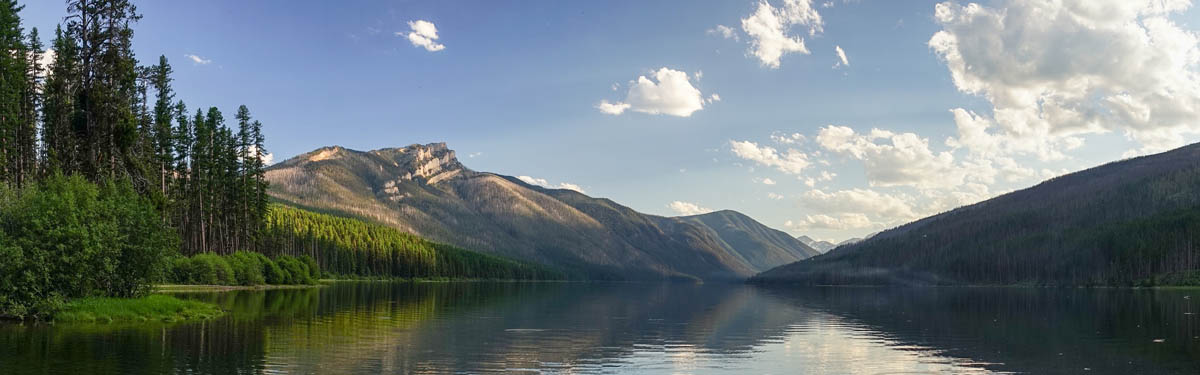
This Wilderness is located on the western side of the Continental Divide entirely within the Flathead National Forest (Hungry Horse and Spotted Bear Ranger Districts), and comprises the northern portion of the Bob Marshall Wilderness Complex.
It forms a critical ecological link with Glacier National Park located just across U.S. Highway 2 to the north. The Great Bear completes the habitat protection for the most significant grizzly bear range in the lower 48 states.
The Great Bear Wilderness extends roughly 36 miles and at its widest point is about 34 miles across. The Middle Fork Flathead River rises in the Great Bear Wilderness and is a Wild and Scenic River through the area for about 50 miles, raging below cliff faces and over boulder strewn rapids in what some refer to as Montana's wildest waterway.
The Wilderness area also contains approximately 310 miles of system trails.
Elevations range from 4000 feet on the Middle Fork to 8,700 feet on Great Northern Mountain.
Located in the Great Bear Wilderness, Schafer Meadows is the location of the only open airstrip within the BMWC. It provides a unique primary access point for the Schafer area as well as the Middle Fork of the Flathead River. The airstrip pre-dates the wilderness designation for the Great Bear and was specified as an "inclusion".
The Great Bear Wilderness encompasses the traditional lands of the Salish (Selis), Kootenai (Ktunaxa), Pend d’Oreille (Qlispe), and Blackfeet (Niitsitapi) peoples. Visitors to the Wilderness today travel along routes, enjoy the land and water's bounty, and camp at sites used for time immemorial by these traditional land and river stewards. Traditional use and connections endure in the area, with tribal members hunting and gathering in the Wilderness, and through river stewardship work by the Confederated Salish and Kootenai Tribe.
The Great Bear Wilderness is part of the Bob Marshall Wilderness Complex. Located in Northwestern Montana on both sides of the Continental Divide, the complex includes three Wilderness areas: the Great Bear, the Scapegoat, and the Bob Marshall Wilderness. Together the complex makes up an area of more than 1.5 million acres, the third largest in the lower 48 states. Grizzly bears, lynx, wolverine, deer, elk, gray wolf, moose, black bear, mountain lion, mountain goat, and mountain sheep roam about these rugged ridge tops, gently sloping alpine meadows, thickly forested river bottoms, and open grass parks. Across this continuous landscape over 1700 miles of trail provide challenges and experiences to satisfy visitors with a wide range of skills.
How to follow the seven standard Leave No Trace principles differs in different parts of the country (desert vs. Rocky Mountains). Click on any of the principles listed below to learn more about how they apply in the Great Bear Wilderness.
For more information on Leave No Trace, Visit the Leave No Trace, Inc. website.
Digital and paper maps are critical tools for wilderness visitors. Online maps can help you plan and prepare for your visit ahead of time. You can also carry digital maps with you on your GPS unit or other handheld GPS device. Having a paper map with you in the backcountry, as well as solid orienteering skills, however, ensures that you can still route-find in the event that your electronic device fails.
Motorized equipment and equipment used for mechanical transport is generally prohibited in all wilderness areas. This includes the use of motor vehicles, motorboats, motorized equipment, bicycles, hang gliders, wagons, carts, portage wheels, and the landing of aircraft including helicopters.
Date: October 28, 1978
Acreage: 285,771 acres
(No official title, designates Great Bear Wilderness) - Public law 95-546 (10/28/1978) To designate the Great Bear Wilderness, Flathead National Forest, and enlarge the Bob Marshall Wilderness, Flathead and Lewis and Clark National Forests, State of Montana
For more information (To download or see all affected wilderness areas) visit our law library for 95-546 or legislative history for 95-546 for this law.
People who volunteer their time to steward our wilderness areas are an essential part of wilderness management. Contact the following groups to inquire about volunteer opportunities. Groups are listed alphabetically by the state(s) in which the wilderness is located.